Posts

Showing posts with the label design

Software Architecture Modelling Using C4

Image
UML appears to be dying in the light of the Agile development movement. working software over comprehensive documentation Many have wrongly interpreted this to mean no documentation. I recently read up C4 model for software architecture that describes the software architecture of a system from different depth & perspectives and for a different audience. The author promotes the use of a common vocabulary to describe software architecture using simple-to-understand diagrams. I attempt to do similar in this post using the same case study as that of the C4 article. The differences are: I do not wish to go into  Class (the 4th C) as that requires too much implementation details I replace the 4th C with Concept as I personally find the Conceptual model more relevant and important in appreciating the business domain.   Using Astah , I figured out how I can model the 4C software architecture efficiently using UML. Mind-Mapping I started with a Mind...
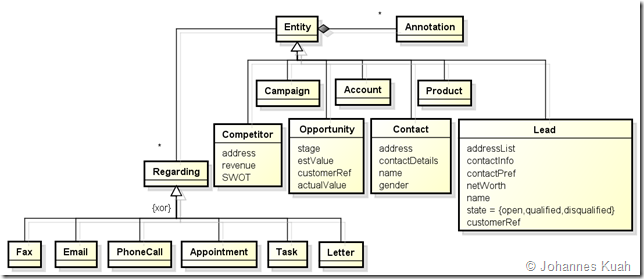
Microsoft CRM Main Concepts & Relationships

Image
I came across MS CRM while searching for a solution for leads management. In the process of trying to appreciate the main concepts and relationships as well as a basic gap analysis against our requirements, I created a set of UML class diagrams to document my understanding. The following are the main concepts (or entities, according to CRM’s nomenclature): Main CRM entities Sales Force entities Sales Person entities Activity entities Teaming entities Campaign entities Main CRM entities Sales Force entities Sales Person entities Activity entities Teaming entities Campaign entities Web References Some useful links for read-up: http://crmdynamo.com/2008/06/crm-40-concepts-what-are-leads-contacts-and-opportunities/ http://blogs.msdn.com/b/crm/archive/2007/08/27/leads-accounts-contacts-and-opportunities.aspx

Developing ASMX Web Services and Controlling the Generated WSDL

Microsoft has made the development of web services very simple for developers who use Visual Studio. Add a web service project and the basic plumbing code is generated! Many developers do not know what goes behind the hood or how to customise the generated WSDL when required. I’ve listed some salient ones that may be of help… Apply [WebService(Namespace = " http://www.johannes.org/webservice/2011/11/03/ ",Name=" ExtendingWebService ", Description=" version 1.0 ")] to the class to get these: < wsdl : definitions targetNamespace = "http://www.johannes.org/webservice/2011/11/03/" > < wsdl : documentation > version 1.0 </ wsdl : documentation > ... < wsdl : service name = "ExtendingWebService" > Apply [WebMethod(Description=" This web service is a typical one ")] to the operation to get this: < wsdl : operation name = "..." > < wsdl : documentation > This web service is a...

Web Services Versioning

You’ve developed the killer web service for your own consumption. You thought that sharing it with others would have been the best thing to do…You give out the WSDL and now, your service consumers are loving it! Weeks and months went by, you need to enhance the application and ripple some of the changes to your killer web service. Now what? Two types of changes There are ( backward-) compatible changes and there are incompatible changes. Examples of compatible ones (these are typically additive changes): Abstract Definitions adding new optional XML schema element or attribute declaration to an existing message definition < xsd : complexType ... > < xsd : sequence > < xsd : element ... /> < xsd : element ... /> < xsd : element ... minOccurs = "0" /> </ xsd : sequence > </ xsd : complexType > adding wildcards (i.e. xsd:any or xsd:anyAttribute) to an existing message definition < xsd : any names...

Logging Levels

Most popular logging frameworks (e.g. Log4J, SLF4J, Log4Net, EntLib) allow for several logging levels to be instrumented. A common question is: What logging levels are appropriate under what scenarios? The following lists some common log levels are their usage: Fatal - Service/ application/ process about to terminate. Unable to proceed with normal operation. Force a shutdown to prevent (further) data loss. Examples: No more system resource (OOM) Error - Unhandled or unexpected system error has occurred. Current operation/ thread to be aborted. Issue needs to be fixed. Still able to continue with normal operation (at least for other users/ sessions) otherwise. Examples: database deadlock Unexpected/ unhandled exception Runtime errors Transaction aborted Can't create file Warn - Things are generally working fine. Recoverable conditions. Transient environmental conditions happened. Something happened (but was handled) that may potentially ...

Useful Design Patterns for Brownfield Projects

Brownfield projects are ubiquitous these days. Greenfield on the other-hand are hard to come by. The ways to deal with both are different. In particular, design patterns that are applicable to brownfield are: Adapter Pattern – adapt a component to another component using a different interface. Proxy Pattern – useful for controlling access to some resource, especially remote ones. Allows decoupling of the client from knowledge of connecting to the service. (Remote) Façade Pattern – to remove the complexity of some service by providing a simplified interface Data Transfer Object – useful in decoupling the views from the data access codes as well as reducing the number of remote invocations to the database layer. Data Access Layer – used to isolate the data access from the users’ interface.

System Architecture and Design Trade-off Document

Image
It is a great idea to write a System Architecture & Design (SAD) Trade-off Document. The format is tabular and will look like the following: Module/ category Issue description Possible alternatives Decision Decision rationale Traded-off attributes Traded-in attributes Consequence/ constraints introduced Some examples of traded attributes are listed in the following table: Category Attribute System Performance Reliability - ability of the system to maintain operating over time (MTTF) Performance - responsiveness of the system to stimuli or events as well as throughput of the system System Control Maintainability - ease with which a system can be modified to correct faults, improve performance, or adapt to changing environment Data timeliness - data latency for information flowing into and out of the system Security - measure of system's ability to resist unauthorised access or DOS Supportability - ease with which a system can be maintained operationally Testa...